The National Testing Agency (NTA) has officially published the NEET Biology syllabus 2026 on December 23. Candidates can now download the latest NEET UG 2026 syllabus for Physics, Chemistry, and Biology to thoroughly analyse the revised chapters, understand updated topic-wise weightage, and design a strategic, exam-focused preparation plan.
Overview of NEET Biology syllabus 2026
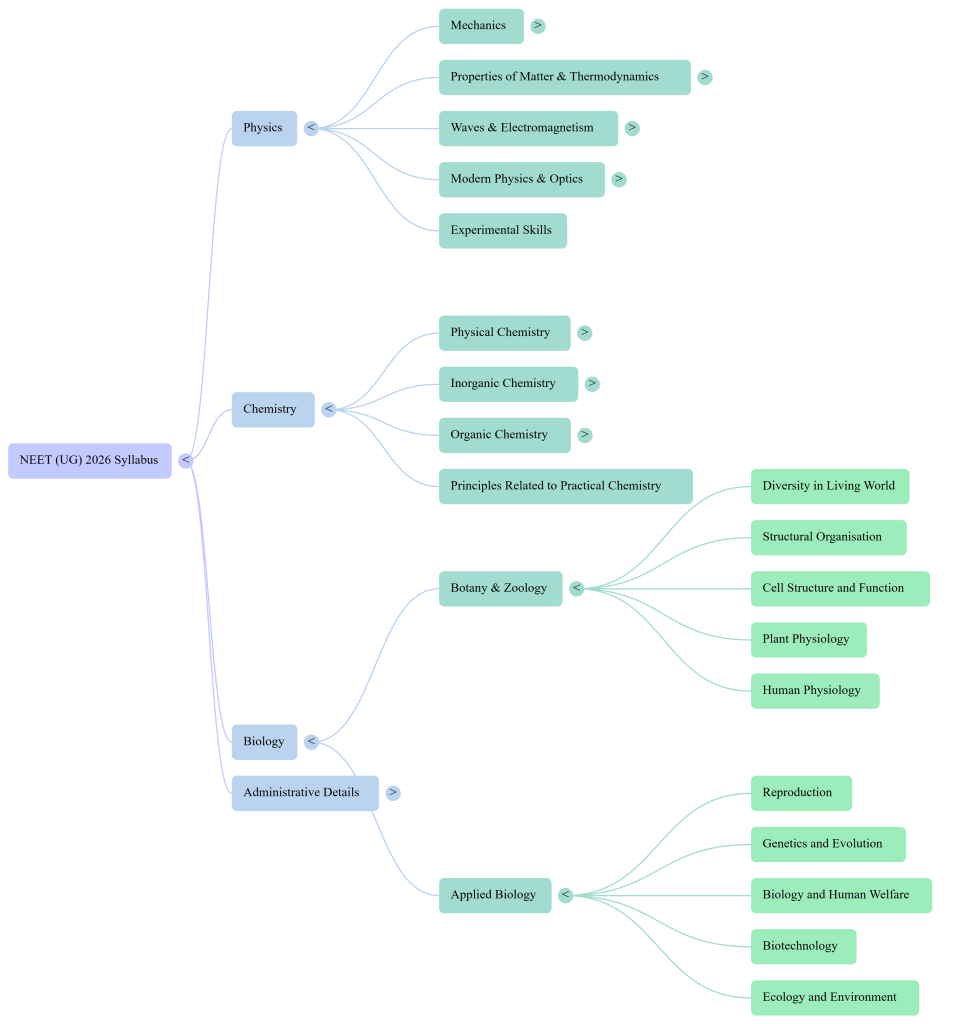
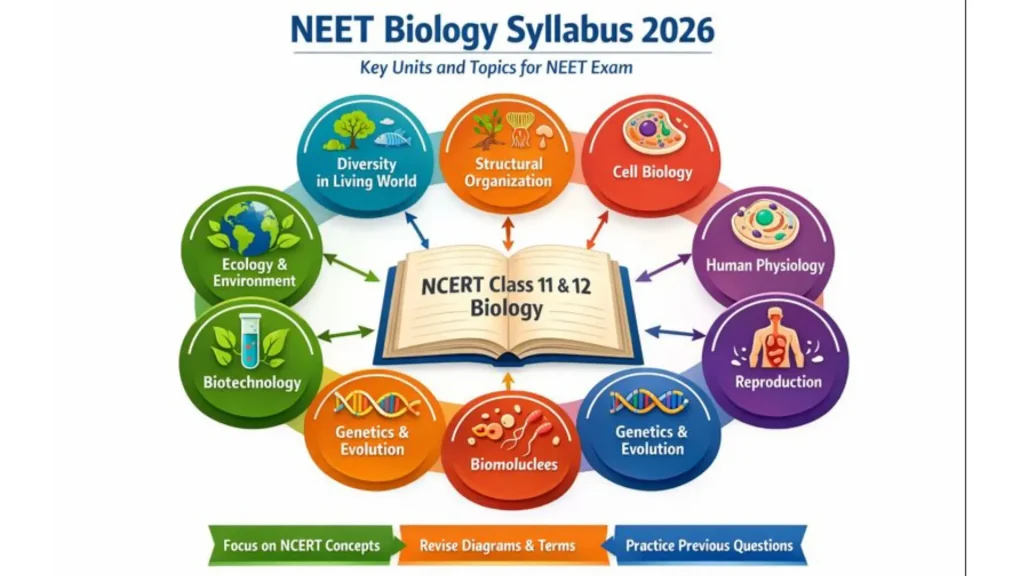
NMC announced NEET Biology syllabus 2026 and NTA follow it, the entire syllabus is from Class 11 and 12 NCERT Biology. It includes all topics related to Diversity in Living World, Cell Structure and Function, Plant and Human Physiology, Reproductions, Genetics & Evolution etc. Since their is maximum weight-age of Biology in NEET, a complete focus on NCERT concepts, diagrams and terminologies is necessary for good preparation And higher scores also.
UNIT 1: Diversity in Living World
- What is living? ; Biodiversity; Need for classification;; Taxonomy & Systematics;
Concept of species and taxonomical hierarchy; Binomial nomenclature; - Five kingdom classification; salient features and classification of Monera; Protista and
Fungi into major groups; Lichens; Viruses and Viroids. - Salient features and classification of plants into major groups-Algae, Bryophytes,
Pteridophytes, Gymnosperms (three to five salient and distinguishing features and at
least two examples of each category); - Salient features and classification of animals-nonchordate up to phyla level and chordate
up to classes level (three to five salient features and at least two examples).
UNIT 2: Structural Organisation in Animals and Plants
- Morphology and modifications; Tissues; Anatomy and functions of different parts of
flowering plants: Root, stem, leaf, inflorescence- cymose and recemose, flower, fruit
and seed (To be dealt along with the relevant practical of the Practical Syllabus) Family
(malvaceae, Cruciferae, leguminocsae, compositae, graminae). - Animal tissues; Morphology, anatomy and functions of different systems (digestive,
circulatory, respiratory, nervous and reproductive) of an insect (Frog). (Brief account
only)
UNIT 3: Cell Structure and Function
- Cell theory and cell as the basic unit of life; Structure of prokaryotic and eukaryotic cell;
Plant cell and animal cell; Cell envelope, cell membrane, cell wall; Cell organelles-
structure and function; Endomembrane system-endoplasmic reticulum, Golgi bodies,
lysosomes, vacuoles; mitochondria, ribosomes, plastids, micro bodies; Cytoskeleton,
cilia, flagella, centrioles (ultra structure and function); Nucleus-nuclear membrane,
chromatin, nucleolus. - Chemical constituents of living cells: Biomolecules-structure and function of proteins,
carbohydrates, lipids, nucleic acids; Enzymes-types, properties, enzyme action,
classification and nomenclature of enzymes - B Cell division: Cell cycle, mitosis, meiosis and their significance.
UNIT 4: Plant Physiology
- Photosynthesis: Photosynthesis as a means of Autotrophic nutrition; Site of
photosynthesis take place; pigments involved in Photosynthesis (Elementary idea);
Photochemical and biosynthetic phases of photosynthesis; Cyclic and non cyclic and photophosphorylation; Chemiosmotic hypothesis; Photorespiration C3 and C4 - pathways; Factors affecting photosynthesis.
- Respiration: Exchange gases; Cellular respiration-glycolysis, fermentation (anaerobic),
TCA cycle and electron transport system (aerobic); Energy relations- Number of ATP
molecules generated; Amphibolic pathways; Respiratory quotient. - Plant growth and development: Seed germination; Phases of Plant growth and plant
growth rate; Conditions of growth; Differentiation, dedifferentiation and
redifferentiation; Sequence of developmental process in a plant cell; Growth regulators-
auxin, gibberellin, cytokinin, ethylene, ABA;
UNIT 5: Human Physiology
- Breathing and Respiration: Respiratory organs in animals (recall only); Respiratory
system in humans; Mechanism of breathing and its regulation in humans-Exchange of
gases, transport of gases and regulation of respiration Respiratory volumes; Disorders
related to respiration-Asthma, Emphysema, Occupational respiratory disorders. - Body fluids and circulation: Composition of blood, blood groups, coagulation of blood;
Composition of lymph and its function; Human circulatory system-Structure of human
heart and blood vessels; Cardiac cycle, cardiac output, ECG, Double circulation;
Regulation of cardiac activity; Disorders of circulatory system-Hypertension, Coronary
artery disease, Angina pectoris, Heart failure. - Excretory products and their elimination: Modes of excretion- Ammonotelism,
ureotelism, uricotelism; Human excretory system-structure and function; Urine
formation, Osmoregulation; Regulation of kidney function-Renin-angiotensin, Atrial
Natriuretic Factor, ADH and Diabetes insipidus; Role of other organs in excretion;
Disorders; Uraemia, Renal failure, Renal calculi, Nephritis; Dialysis and artificial
kidney. - Locomotion and Movement: Types of movement- ciliary, fiagellar, muscular; Skeletal
muscle- contractile proteins and muscle contraction; Skeletal system and its functions
(To be dealt with the relevant practical of Practical syllabus); Joints; Disorders of
muscular and skeletal system-Myasthenia gravis, Tetany, Muscular dystrophy, Arthritis,
Osteoporosis, Gout. - Neural control and coordination: Neuron and nerves; Nervous system in human scentral
nervous system, peripheral nervous system and visceral nervous system; Generation and
conduction of nerve impulse; - Chemical coordination and regulation: Endocrine glands and hormones; Human
endocrine system-Hypothalamus, Pituitary, Pineal, Thyroid, Parathyroid, Adrenal,
Pancreas, Gonads; Mechanism of hormone action (Elementary Idea); Role of hormones
as messengers and regulators, Hypo-and hyperactivity and related disorders (Common
disorders e.g. Dwarfism, Acromegaly, Cretinism, goiter, exopthalmic goiter, diabetes,
Addison’s disease).
(Imp: Diseases and disorders mentioned above to be dealt in brief.)
NEET Biology syllabus 2026 DOWNLOAD PDF
UNIT 6: Reproduction
- Sexual reproduction in flowering plants: Flower structure; Development of male and
female gametophytes; Pollination-types, agencies and examples; Outbreeding devices;
Pollen-Pistil interaction; Double fertilization; Post fertilization events- Development of
endosperm and embryo, Development of seed and formation of fruit; Special modes-
apomixis, parthenocarpy, polyembryony; Significance of seed and fruit formation. - Human Reproduction: Male and female reproductive systems; Microscopic anatomy of
testis and ovary; Gametogenesis-spermatogenesis & oogenesis; Menstrual cycle;
Fertilisation, embryo development upto blastocyst formation, implantation; Pregnancy
and placenta formation (Elementary idea); Parturition (Elementary idea); Lactation
(Elementary idea). - Reproductive health: Need for reproductive health and prevention of sexually
transmitted diseases (STD); Birth control-Need and Methods, Contraception and
Medical Termination of Pregnancy (MTP); Amniocentesis; Infertility and assisted
reproductive technologies – IVF, ZIFT, GIFT (Elementary idea for general awareness).
UNIT 7: Genetics and Evolution
- Heredity and variation: Mendelian Inheritance; Deviations from Mendelism-
Incomplete dominance, Co-dominance, Multiple alleles and Inheritance of blood
groups, Pleiotropy; Elementary idea of polygenic inheritance; Chromosome theory of
inheritance; Chromosomes and genes; Sex determination-In humans, birds, honey bee;
Linkage and crossing over; Sex linked inheritance-Haemophilia, Colour blindness;
Mendelian disorders in humans-Thalassemia; Chromosomal disorders in humans;
Down’s syndrome, Turner’s and Klinefelter’s syndromes. - Molecular basis of Inheritance: Search for genetic material and DNA as genetic
material; Structure of DNA and RNA; DNA packaging; DNA replication; Central
dogma; Transcription, genetic code, translation; Gene expression and regulation- Lac
Operon; Genome and human genome project; DNA finger printing, protein
biosynthesis. - Evolution: Origin of life; Biological evolution and evidences for biological evolution
from Paleontology, comparative anatomy, embryology and molecular evidence);
Darwin’s contribution, Modern Synthetic theory of Evolution; Mechanism of evolution-
Variation (Mutation and Recombination) and Natural Selection with examples, types of
natural selection; Gene flow and genetic drift; Hardy-Weinberg’s principle; Adaptive
Radiation; Human evolution.
READ MORE : NEET Physics syllabus 2026
UNIT 8: Biology and Human Welfare
- Health and Disease; Pathogens; parasites causing human diseases (Malaria, Filariasis,
Ascariasis. Typhoid, Pneumonia, common cold, amoebiasis, ring worm, dengue,
chikungunya); Basic concepts of immunology-vaccines; Cancer, HIV and AIDS;
Adolescence, drug and alcohol abuse.Tobacco abuse Microbes in human welfare: In household food processing, industrial production,
sewage treatment, energy generation and as biocontrol agents and biofertilizers.
UNIT 9: Biotechnology and Its Applications
- Principles and process of Biotechnology: Genetic engineering (Recombinant DNA
technology). - Application of Biotechnology in health and agriculture: Human insulin and vaccine
production, gene therapy; Genetically modified organisms-Bt crops; Transgenic
Animals; Biosafety issues-Biopiracy and patents.
UNIT 10: Ecology and Environment
- Organisms and environment Population interactions-mutualism, competition, predation,
parasitism; Population attributes-growth, birth rate and death rate, age distribution. - Ecosystem: Patterns, components; productivity and decomposition; Energy flow;
Pyramids of number, biomass, energy - Biodiversity and its conservation: Concept of Biodiversity; Patterns of Biodiversity;
Importance of Biodiversity; Loss of Biodiversity; Biodiversity conservation; Hotspots,
endangered organisms, extinction, Red Data Book, biosphere reserves, National parks
and sanctuaries, Sacred Groves.
In conclusion, the NEET Biology syllabus is vast and significantly contributes to a candidate’s marks. Aligned to the NCERT Class 11 and 12 books, the syllabus requires candidates to have a clear understanding of concepts, diagrams, and labels used in them. A person can prepare and do well in Biology and the subsequent NEET exam through creating a study timetable, revision, and solving NCERT structured questions.
NEET Biology Syllabus 2026 – Unit-wise Table
| Unit No. | Unit Name | Important Topics Covered | NEET Focus |
|---|---|---|---|
| Unit 1 | Diversity in Living World | Living world, biological classification, plant & animal kingdoms, biodiversity | Direct NCERT questions |
| Unit 2 | Structural Organisation in Animals & Plants | Morphology, anatomy, tissues, frog & cockroach | Diagrams & structure-based |
| Unit 3 | Cell Structure & Function | Cell theory, biomolecules, enzymes, cell cycle, mitosis & meiosis | Concept + diagrams |
| Unit 4 | Plant Physiology | Photosynthesis, respiration, transpiration, plant hormones | Application-based |
| Unit 5 | Human Physiology | Digestion, respiration, circulation, excretion, nervous & endocrine systems | Highest weightage |
| Unit 6 | Reproduction | Reproduction in organisms, human reproduction, reproductive health | NCERT lines & diagrams |
| Unit 7 | Genetics & Evolution | Mendelism, molecular inheritance, evolution theories | Concept-heavy |
| Unit 8 | Biology & Human Welfare | Human health, diseases, microbes, immunology | Factual & scoring |
| Unit 9 | Biotechnology & Its Applications | Genetic engineering, biotech tools, applications | High-yield & repeated |
| Unit 10 | Ecology & Environment | Ecosystem, biodiversity, environmental issues | Easy & predictable |
Expert’s Advice on NEET Biology syllabus 2026
As an experienced NEET mentor, my strongest advice for Biology preparation is clear: NCERT is indispensable. The NEET Biology syllabus is almost entirely derived from Class 11 and Class 12 NCERT, with most questions—direct or indirect—based on its lines, diagrams, tables, and examples.
Begin by building conceptual clarity, especially in high-weightage units such as Human Physiology, Genetics and Evolution, Reproduction, and Cell Biology. These topics consistently carry more questions and are repeated year after year with slight variations. Avoid rushing—focus on understanding the logic, flowcharts, and biological processes thoroughly.
Biology is not just about memorization; it’s about smart retention. Create concise notes for definitions, keywords, scientific names, and exceptions. Regularly revise diagrams—NEET frequently tests labeling, structure-based understanding, and uses NCERT figures directly. For Ecology and Environment, repeated reading and quick revision are more effective than deep analysis.
A common mistake students make is solving too many non-NCERT questions. While practice is important, prioritizing previous year NEET questions and NCERT-based MCQs is essential. Carefully analyze your mistakes and immediately revise the relevant NCERT section.
Finally, consistency is the real game-changer. Daily revision, regular self-testing, and multiple NCERT readings can elevate your Biology score above 320–340. If you respect the NEET Biology syllabus 2026, trust NCERT, and revise strategically, Biology can become your strongest asset in NEET
NEET SYLLABUS DOWNLOAD PDF
FAQ on NEET Biology Syllabus 2026
Q1. Who released the NEET Biology syllabus 2026?
Ans: The NEET Biology syllabus 2026 was released by the National Medical Commission (NMC) and followed by NTA.
Q2. Is the NEET Biology syllabus 2026 based on NCERT?
Ans: The NEET Biology syllabus 2026 is completely based on Class 11 and Class 12 NCERT Biology.
Q3.How many units are there in the NEET Biology syllabus 2026?
Ans: The Biology syllabus consists of 10 major units covering Botany and Zoology.
Q4. Which topics are most important in NEET Biology?
Ans: High-weightage topics include Human Physiology, Genetics and Evolution, Reproduction, Cell Biology, and Ecology.
Q5. Does NEET Biology include Biotechnology and Ecology?
Ans: Biotechnology and Its Applications and Ecology and Environment are important parts of the NEET Biology 2026.
Q6. How should students prepare for NEET Biology 2026?
Ans: Students should focus on NCERT textbooks, revise diagrams and definitions, and practice previous year questions regularly..
Q7. Has the NEET Physics syllabus changed for 2026?
Ans: NTA has released an updated syllabus, and candidates should refer to the official PDF for any revisions.